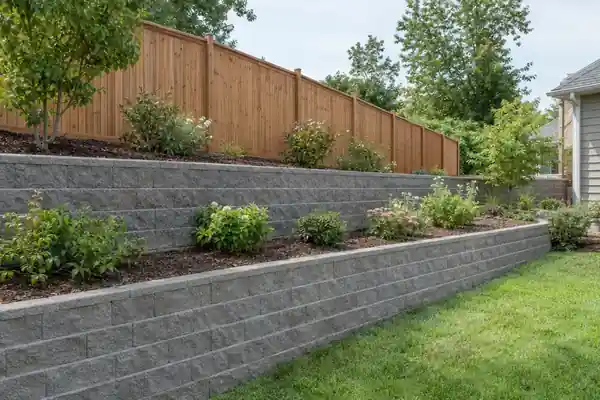
When Does a Yard Need a Retaining Wall?
A yard usually needs a retaining wall when soil is visibly washing away after rain, a slope is too steep to mow or plant safely, or a drop-off beside a driveway or patio keeps shifting. Catching it early costs less than repairing a structure the erosion has already undermined.
Sign 1: Soil Loss After Rain
Soil loss after rain is the clearest early sign. If a slope sheds dirt onto a walk or driveway every storm, the hill is moving and is likely to keep moving.
Sign 2: A Slope You Can’t Use
A slope you can’t mow or plant safely is a yard you’re paying taxes on and can’t use. A wall can turn it into level, usable ground.
Sign 3: A Shifting Drop-Off
A drop-off that keeps shifting next to a driveway or patio can start to undermine that slab. That’s the point to call, before the damage reaches a structure.
Drainage Behind the Wall
Drainage behind the wall is essential. Water trapped behind a retaining wall builds pressure, and that pressure is a common reason walls fail.
Block vs. Poured Retaining Walls
Block and poured retaining walls each have a place. Block walls generally cost less up front and build faster with modular units, while poured concrete costs more but can offer a more continuous wall for taller applications.
What to Have Ready for an Estimate
An estimate goes faster when you know roughly how long and how tall the wall needs to be, what sits above it (a lawn, a patio, a driveway), and where water runs during a heavy rain.
What a Retaining Wall Costs
Retaining wall costs vary too much for a single starting price, so every project gets a free estimate. For reference, block retaining walls run roughly $15 to $35 per square foot and poured concrete walls roughly $20 to $45 in published cost guides. Taller walls may need engineering, and we’ll tell you if yours does. Our Retaining Walls page has more, and if the wall needs a masonry face, see our post on brick veneer vs. full brick.