Which Costs Less, Block or Poured?
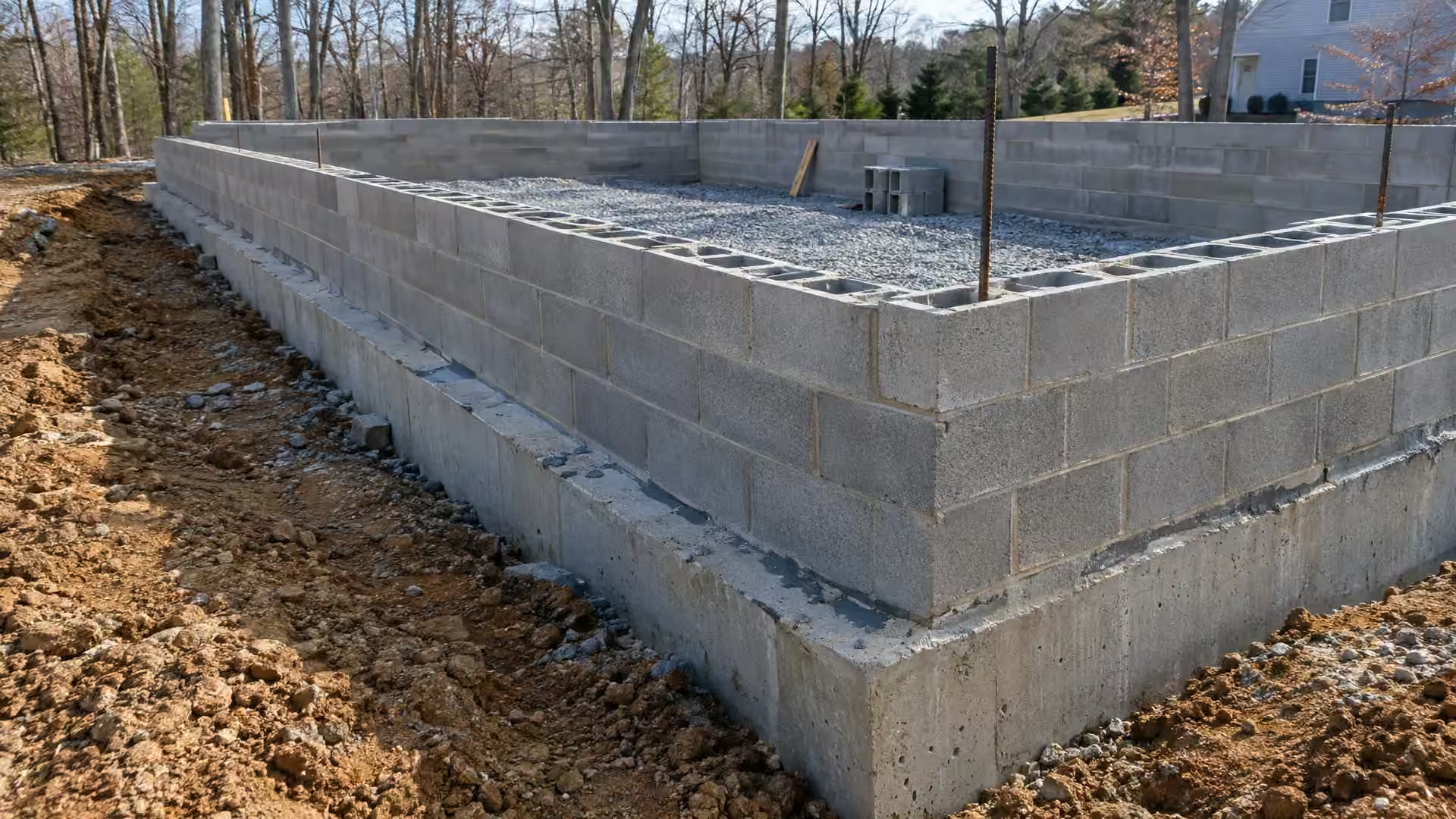
A concrete block foundation usually costs less than a poured concrete foundation. Poured walls need forms built on site and more concrete per foot of wall, while block goes up course by course from modular units. Tidewater’s block foundations start at $50 per linear foot, footer included.
Why Poured Walls Cost More
Poured walls cost more for the two reasons our owner gives when customers ask: material and forms. A poured wall is solid concrete from the footer to the top, so it uses more concrete per linear foot than a wall built from hollow-core block. The crew also has to build, set and strip forms on site, and those forms are expensive.
Concrete block foundations cost less than poured ones, and poured basement foundations can climb to about $50 per square foot, according to fixr.com’s foundation cost guide.
What a Block Foundation Costs Here
A block foundation from Tidewater starts at $50 per linear foot at 5 courses (40 inches high), with the footer included. Each additional course adds $10 per linear foot.
A recent 20-by-28-foot garage foundation, 96 linear feet at 5 courses and 16 inches out of the ground, came to $5,000 to $6,000.
How That Compares to Itemized Quotes
Itemized quotes often split the footer and the wall into two line items. Footing work alone runs roughly $10 to $15 per linear foot in published cost guides, and block wall construction $20 to $60 per linear foot depending on block type and reinforcement. Our combined rate covers both.
How Frost Depth Sets the Number of Courses
Frost depth decides how far down a footer has to go, and that sets how many courses of block the wall needs. Cecil County’s building code puts the frost line at 32 inches, and New Castle County’s footing checklist calls for the base of every footing to sit 32 inches below finished grade.
With a typical 8-inch footer bottoming out at 32 inches, 5 courses (40 inches) of block brings the top of the wall about 16 inches above grade. That is exactly where our 20 x 28 garage example landed, and it’s why 5 courses is our starting price point. Each course beyond that adds $10 per linear foot.
When a Poured Foundation Makes Sense
A poured foundation can make sense for a deep, full-height basement, where a continuous wall with fewer joints matters more. For garages, pole barns and additions, the foundations we build most, block is usually the more cost-effective choice.
Footers and Additions
Footers are included in our linear-foot rate, so a block foundation quote from us is one number for the footer and the wall together. Addition foundations use the same model as garage foundations. Our Concrete Block Foundations page covers the full service.
Winter Foundation Work
Winter foundation work is something we schedule on purpose. Block foundations are one of the services we keep running through the cold months, so a project that needs its foundation in before spring has a realistic path.